
Introduction
In opposition to modernism, postmodernism arose as an intellectual and cultural movement in the middle of the 20th century. Characterized by skepticism towards grand narratives, a focus on individual perspective, and an embrace of ambiguity, fragmentation, irony, the blurring of boundaries between reality and fiction. Postmodern authors tend to reject direct meanings in their novels, stories, and poems, and, instead, highlight the possibility of multiple meanings, or a complete lack of meaning, within a single literary work.
Alice Walker's The Color Purple (1982) can be viewed from a postmodern perspective, particularly when examined in its historical context. The novel addresses issues of race, gender, Identity, and power while departing from traditional literary forms and structures.
Postmodernism: An overview
First of all, postmodernism does not have a clear-cut definition, it is an idea that emerged against the widespread concept of modernism in the mid-20th c. Postmodernism is difficult to describe and understand as it is a very abstract concept with multifarious approaches and meanings to literature. This movement was a reaction against modernism for which the world is a beautiful place and its reality that could only be understood by the human mind, through time scientists increased the application of rational thinking to the world around them. Therefore, for modernists science and its findings are a reflection of reality. People believed that science could find a solution to all their problems and all the plagues or diseases. Nevertheless, a couple of centuries later, people started to realize that modernism started to fail at various levels. first, the science that humans strongly believed in, caused environmental degradations such as ozone depression…..etc. as well as the development of a totalitarian society that is a system of government that is dictatorial, finally the most crucial point is the global wars with atomic potential that occurred under modernist period .
People finally realise that reason and science did not lead to utopia. As people began to understand these truths then started reactions against modernism. The two most important reactions against modernism were the despair of existentialism and postmodernism. Henceforth, postmodernism is the rejection of the modern view of things it is the theory of rejecting theories. Postmodernism was not related to literature only but existed in other disciplines also such as films, architecture, philosophy, art, and culture. Its only focus was to contradict modernism at any level
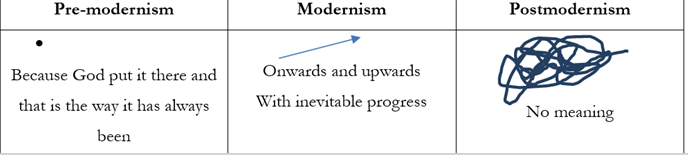
During the pre-modern period, people were devoted to theology and believed that anything that existed was because of God's potential. Then comes the modern period with the discovery of the Big Bang theory and all the other scientific discoveries expended the knowledge of human beings. Then, the postmodern period contradicts all that was said previously. Since everything has to be questioned and nothing has become simple anymore. Consequently, a new era and new understanding of all the art forms emerged.
Postmodernism in Literature
Postmodern literature is a type of literature that came to prominence after World War II. It is a form of literature which is marked, both stylistically and ideologically, by a reliance on such literary conventions as fragmentation, paradox, unreliable narrators, often unrealistic and downright impossible plots, games, parody, paranoia, dark humor and authorial self-reference. Postmodern writers tend to reject outright meanings in their novels, stories and poems, and, instead, highlight and celebrate the possibility of multiple meanings, or a complete lack of meaning, within a single literary work. Postmodern literature also often rejects the boundaries between 'high' and 'low' forms of art and literature, as well as the distinctions between different genres and forms of writing and storytelling. Here are some examples of stylistic techniques that are often used in post- modern literature.
Pastiche : The taking of various ideas from previous writings and literary styles and pasting them together to make new styles.
Intertextuality: The acknowledgement of previous literary works with another literary work. Metafiction: The act of writing about writing or making readers aware of the fictional nature of the very fiction they are reading .
Temporal Distortion: use of non-linear timelines and narrative techniques in a story.
Magical Realism: The introduction of impossible or unrealistic events without clearly defining what is factual or what is fictional.
Reader involvement: Often through direct address to the reader and the open acknowledgement of the fictional nature of the events being described.
Post-Modern America: Historical background
With the advances in technology and rights, Americans could better define who they were. Americans now saw themselves as a major world power because of their atomic bombs. Women and African Americans also began developing a voice and identity distinct in American culture. With people like Martin Luther King and Malcolm X leading the civil rights movement, the African-American identity started becoming recognized by society because not everyone supported this. Racism also became another important theme of the contemporary era. These events influenced the writing of this era that displays the diversity, materialism and pride seen throughout America. Postmodernism focused on the present and the future. It was and is an ongoing, evolving period of American literature.
Alice Walker: A Short Biography
Alice Walker (b. 1944) is an American writer, poet, and activist known for her insightful portrayal of African American life and culture. Her 1982 novel The Color Purple was the subject of a major motion picture and Broadway musical. Alice Walker’s The Color Purple (1982) is often classified as a work of modernism due to its focus on individual suffering, identity, and race, but it also contains numerous postmodern characteristics. Walker’s use of narrative techniques, themes, and content places The Color Purple within the realm of postmodernism, as it challenges traditional literary forms and engages in self-awareness, intertextuality, and a rejection of grand narratives
Historical context of The Color Purple as Postmodernist Text
The Color Purple (1982) by Alice Walker is set in the early 20th century, primarily in the rural South, during a time of racial segregation and gender inequality in the United States. This historical context deeply shapes the novel’s exploration of race, gender, identity, and power. The story follows Celie, an African American woman who faces both physical and emotional abuse, and her journey toward self-discovery, empowerment, and liberation.
The novel is significant not only for its depiction of African American women’s lives during this period but also for its innovative narrative style, which aligns with postmodernist themes. The Color Purple breaks from traditional literary conventions, using an epistolary format—letters written by Celie to God and later to her sister, Nettie—which offers an intimate and fragmented perspective on her experiences. This structure allows for a deep exploration of Celie's subjective reality, emphasizing the postmodernist focus on individual perspective.
In addition, the novel challenges conventional storytelling by presenting multiple viewpoints and incorporating a range of voices, including those of women, African Americans, and marginalized groups. The nonlinear structure, the use of dialect, and the subversion of traditional gender roles reflect postmodernist elements that question authority, traditional power structures, and accepted truths.
Walker also tackles themes like the intersectionality of race and gender, subverting expectations of the time and presenting a radical departure from the dominant narratives about African American and female identity. This questioning of societal norms, alongside the novel’s focus on personal transformation and liberation, makes The Color Purple a key example of postmodernism in literature.
Conclusion
Postmodern literature represents a radical break from the traditions of modernism, embracing skepticism, fragmentation, and relativism. It challenges readers to question conventional narratives, understandings of truth, and the nature of reality itself. Through techniques like metafiction, intertextuality, and pastiche, postmodern writers have reshaped the landscape of literature, creating works that reflect the complexities, uncertainties, and absurdities of the postmodern world. By engaging with these characteristics and techniques, postmodern literature invites readers to engage in a more active, questioning, and self-reflexive relationship with the text.
Suggested References for Further Reading
· Fredric Jameson. Postmodernism, or, The Cultural Logic of Late Capitalism (1991)
· Jean Baudrillard. Simulacra and Simulation (1981
· Linda Hutcheon. A Poetics of Postmodernism: History, Theory, Fiction (1988)
· Charles Jencks. The Postmodern Condition