Very often, the bit of information we are searching for comes back to us, but sometimes it does not. Clearly, forgetting seems to be a natural part of life. Why do we forget?
-Encoding failures: One very common and obvious reason why you cannot remember a piece of information is because you did not learn it in the first place. If you fail to encode information into memory, you are not going to remember it later on. Usually, encoding failures occur because we are distracted or are not paying attention to specific details.
-Memories decay : Another proposed reason why we forget is that memories fade, or decay, over time. It has been known since the work of Hermann Ebbinghaus that as time passes, memories get harder to recall.
Common Types of Forgetting :
Memory complex interactions with sensation, perception, and attention sometimes render certain memories irretrievable:
-Absentmindedness :If you have ever put down your keys when you entered your house and then could not find them later, you have experienced absentmindedness. Attention and memory are closely related, and absentmindedness involves problems at the point where attention and memory interface. Common errors of this type include misplacing objects or forgetting appointments. Absentmindedness occurs because at the time of encoding, sufficient attention was not paid to what would later need to be recalled.
-Blocking :Occasionally, a person will experience a specific type of retrieval failure called blocking. Blocking is when the brain tries to retrieve or encode information, but another memory interferes with it. Blocking is a primary cause of the tip-of-the-tongue phenomenon. This is the failure to retrieve a word from memory, combined with partial recall and the feeling that retrieval is imminent. People who experience this can often recall one or more features of the target word, such as the first letter, words that sound similar, or words that have a similar meaning. Sometimes a hint can help them remember: another example of cued memory.
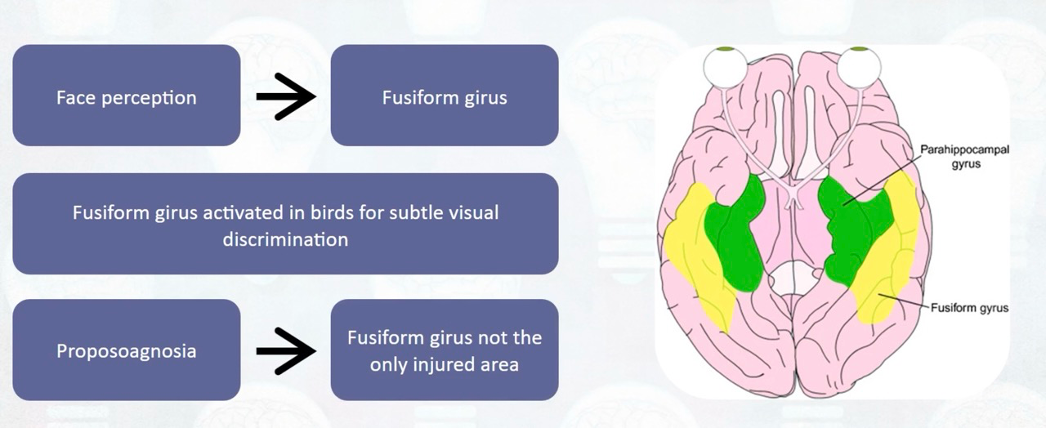
-Proposoagnosia is the impaired ability to recognise face identities. It is thought that face perception relies on the fusiform girus, and we also observe that the fusiform girus, activated in birds for subtle visual discrimination. But we observe that people with Proposoagnosia, fusiform girus is not the only injured area there.