2. A Focus on Short-Term Memory
2.1. Models of Short-Term Memory
There are several models that attempt to explain how short-term memory works:
1. Multi-Store Model (Atkinson-Shiffrin Model)
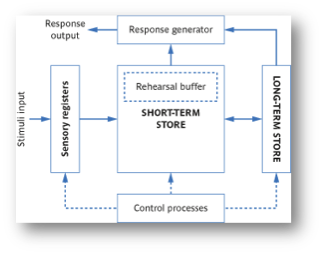
This model proposes that information passes through three distinct stages to be stored in long-term memory:
- Sensory Memory/Register: Briefly stores sensory information, lasting no more than a half-second for visual information and 3-4 seconds for auditory information.
- Short-Term Memory: Temporarily stores, organizes, and manipulates information, typically for 20 to 30 seconds.
- Long-Term Memory: Continuously stores information, with a very large storage capacity. This model suggests that we process memories in the same way a computer processes information. This model suggests that the short-term store is modality-independent, which has been shown to be incorrect since short-term memory deals with verbal and visuo-spatial information in distinct subsystems. Also, the short-term store cannot be considered a single unit as one task can interfere with another task using the same resources, but a concurrent visual task does not impair a verbal task.
2. Unitary-Store Model
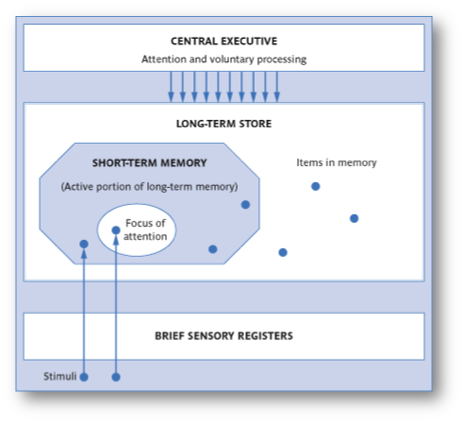
This model suggests that there is only one memory store, which is long-term memory (LTM). Short-term memories are temporary activations of long-term representations. This means that stored contents (representations) in LTM can be temporarily activated, and these activations form the content of STM.
3. Working Memory Model (Baddeley & Hitch)
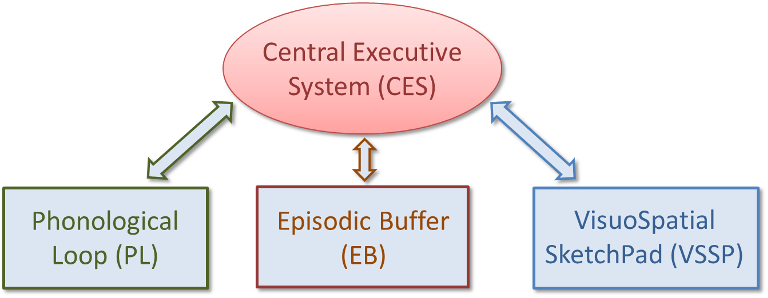
This model replaces the concept of the short-term store with working memory. It has four components:
- Central Executive: An attentional system that monitors the other three stores.
- Phonological Loop: Stores verbal information.
- It includes a phonological store that holds items passively and a rehearsal process that refreshes the memory.
- Verbal information is encoded as a series of sounds.
- Visuo-Spatial Sketchpad: Processes visual and spatial information. It is divided into the visual cache (holds visuospatial information) and the inner scribe (carries out cognitive operations).
- Episodic Buffer: Organizes all information by providing temporary storage for integrated information from all components.