Memory
| الموقع: | usmt |
| مقرر الدراسي: | Cognitive Psychology - Dr.Chamkha |
| كتاب: | Memory |
| طبع بواسطة: | مستخدم ضيف |
| التاريخ: | الثلاثاء، 13 أكتوبر 2026، 6:18 AM |
1. Intro
What is Memory?
The study of human memory has been a subject of science and philosophy for thousands of years. Memory is a dynamic mechanism associated with storing, retaining, and retrieving information. It's not just one thing but involves multiple processes and different types of storage.
The word "memory" has three primary definitions:
- Memory Store: A location where information is kept.
- Memory Trace or Engram: The thing that holds the contents of experience, where each memory is a different mental representation.
- Mental Process: The process used to acquire, store, and retrieve information.
Memory Stages
There are three main stages of memory processing:
- Encoding: Transforming sensory data into a mental representation. This involves receiving, processing, and combining information.
- Encoding can occur through automatic processing (without conscious awareness) or effortful processing (requiring attention).
- There are different types of encoding, including visual (images), acoustic (sounds, words), and semantic (meaning). Semantic encoding generally leads to better recall.
- Storage: Keeping encoded information in memory. This creates a permanent record of information.
- Retrieval: Pulling out or using information stored in memory. There are three ways to retrieve information: recall (accessing information without cues), recognition (identifying previously learned information), and relearning (learning previously learned information again).
2. A Focus on Short-Term Memory
Short-Term Memory (STM)
Short-term memory is a temporary storage system for processing incoming sensory information. It's also called primary memory, active memory, or immediate memory. STM holds a small amount of information in an active, readily available state for a short period of time.
STM vs. Working Memory (WM)
STM and WM are often used synonymously, but they are different concepts:
- STM is for short-term storage of information, like remembering a phone number.
- WM includes short-term storage of information and the capacity to manipulate this information, like switching the digits in a phone number.
Testing STM
Memory is tested by having participants memorize items and testing how many they remembered after some time. Testing methods include:
- Free Recall: Participants reproduce items freely, such as writing them on a blank sheet.
- Recognition: Participants identify the memorized items among new items.
Phases of a STM Task
STM tasks generally have three phases:
- Item Presentation: Encoding information into STM.
- Retention Interval: Keeping information active in STM.
- Test Phase: Retrieving information.
Serial Position Effect
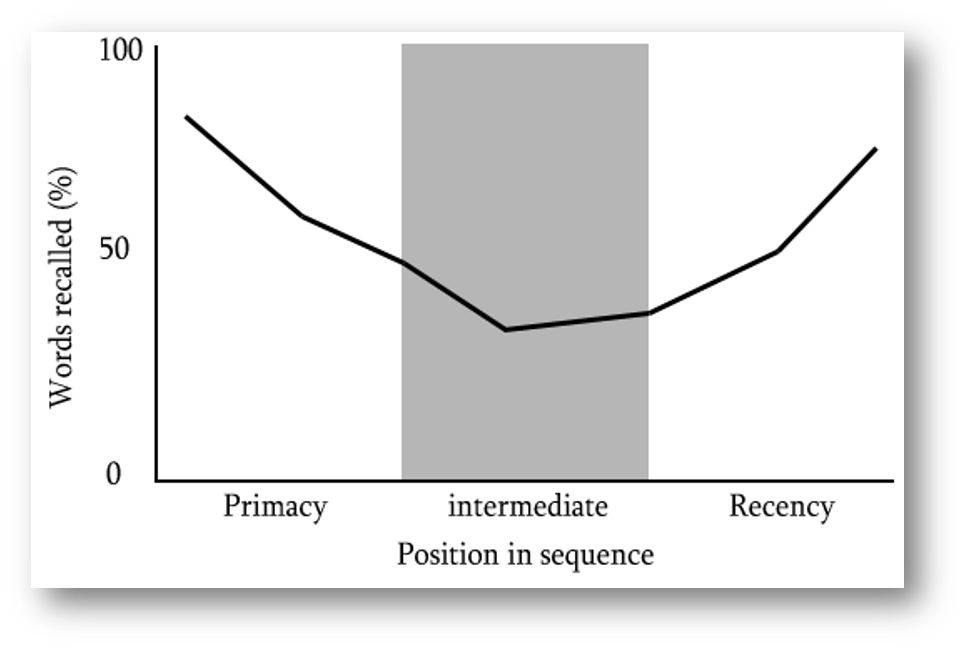
In a free recall task, the serial position effect is observed. This is a U-shaped curve where the first and last items are remembered better than the middle items. This effect has two parts:
- Primacy Effect: Early words are remembered better because they can be rehearsed more often. These words are more likely to move into long-term memory.
- Recency Effect: Last words are still in memory. This effect is reduced by adding a task during the retention interval.
Capacity of STM
Most people can retain about 7 items (plus or minus 2) in short-term memory. The capacity of STM is not about the amount of information but how it is grouped into "chunks".
Chunking
Chunking involves organizing information into manageable bits. A "chunk" is a collection of elements with strong associations to each other, but weak associations with other chunks. STM capacity is limited by the number of chunks.
- For example, the letters "PACKLOADFILL" can be chunked into three words which may be easier to remember than twelve individual letters.
2.1. Models of Short-Term Memory
There are several models that attempt to explain how short-term memory works:
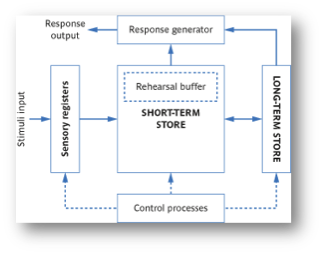
1. Multi-Store Model (Atkinson-Shiffrin Model)
This model proposes that information passes through three distinct stages to be stored in long-term memory:
- Sensory Memory/Register: Briefly stores sensory information, lasting no more than a half-second for visual information and 3-4 seconds for auditory information.
- Short-Term Memory: Temporarily stores, organizes, and manipulates information, typically for 20 to 30 seconds.
- Long-Term Memory: Continuously stores information, with a very large storage capacity. This model suggests that we process memories in the same way a computer processes information. This model suggests that the short-term store is modality-independent, which has been shown to be incorrect since short-term memory deals with verbal and visuo-spatial information in distinct subsystems. Also, the short-term store cannot be considered a single unit as one task can interfere with another task using the same resources, but a concurrent visual task does not impair a verbal task.
2. Unitary-Store Model
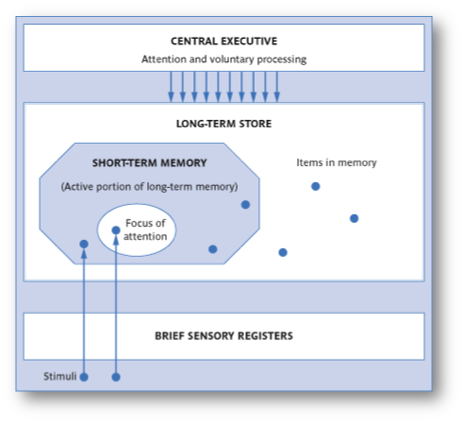
This model suggests that there is only one memory store, which is long-term memory (LTM). Short-term memories are temporary activations of long-term representations. This means that stored contents (representations) in LTM can be temporarily activated, and these activations form the content of STM.
3. Working Memory Model (Baddeley & Hitch)
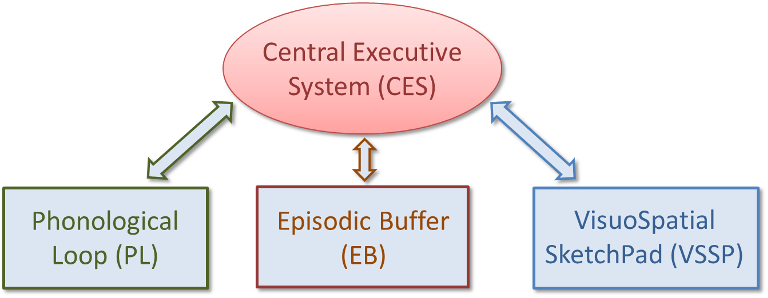
This model replaces the concept of the short-term store with working memory. It has four components:
- Central Executive: An attentional system that monitors the other three stores.
- Phonological Loop: Stores verbal information.
- It includes a phonological store that holds items passively and a rehearsal process that refreshes the memory.
- Verbal information is encoded as a series of sounds.
- Visuo-Spatial Sketchpad: Processes visual and spatial information. It is divided into the visual cache (holds visuospatial information) and the inner scribe (carries out cognitive operations).
- Episodic Buffer: Organizes all information by providing temporary storage for integrated information from all components.
2.2. More on Components of STM
The working memory model provides a more detailed look at the components of STM:
Sensory Registers
Sensory registers hold information very briefly. There are separate stores for visual (iconic) and auditory (echoic) information.
- Iconic memory (sensory register for vision) has a span of approximately 8-9 letters.
Verbal STM
Verbal information is encoded as a series of sounds. Even when visual information is presented, it may be rehearsed verbally.
- Word length effect: the longer it takes to say items, the fewer items can be remembered, suggesting that verbal STM is time-limited.
Visuospatial STM
Visuospatial STM processes visual and spatial information. Mental rotation tasks show that response times increase with the amount of rotation needed, indicating that visuospatial operations work in an analogue way.
Control Processes
These processes control and coordinate the contents of short-term memory, the flow of information between components, and control of attention.
In summary, short-term memory is a complex system with different components and processes that work together to allow us to temporarily hold and manipulate information. Understanding the different models and mechanisms involved in STM is essential for understanding how we process information and learn.
3. A Focus on Long-term Memory
Long-term memory (LTM) is the continuous storage of information, with a very large storage capacity. It encompasses all the things you can remember that happened more than just a few minutes ago to all of the things that you can remember that happened days, weeks, and years ago.
Here are some key aspects of long-term memory:
- Storage Capacity: Unlike short-term memory, the storage capacity of long-term memory has no known limits. It's considered to have an essentially unlimited capacity.
- Duration: Information in long-term memory is stored permanently. While short-term memory lasts for seconds to minutes, long-term memory stores information over very long periods of time.
- Accessibility: Some information in LTM is easy to recall, while other memories are more difficult to access. Some long-term memories can only be recalled through prompts.
- Relationship to Short-Term Memory (STM): Information in short-term memory can be transferred to long-term memory for more permanent storage. In the multi-store model, information passes through sensory memory, then short-term memory, and finally into long-term memory. The unitary-store model, however, proposes that short-term memory is just the temporarily activated part of long-term memory.
Types of Information Stored in LTM
- LTM includes all kinds of memories, such as facts, procedures, and personal experiences.
- LTM stores information that is largely outside of our awareness but can be called into working memory to be used when needed.
Models of Memory and Long-Term Memory
- Atkinson-Shiffrin Model: In this multi-store model, LTM is one of three distinct stages of memory, along with sensory memory and short-term memory. This model proposes that information moves through these stages in a linear sequence.
- Unitary-Store Model: This model contrasts with the multi-store model by proposing that LTM is the only memory store, and short-term memory is just a temporarily activated part of long-term memory.
Retrieval of Information from Long-Term Memory
- Retrieval is the process of accessing stored information. There are three ways to retrieve information from long-term memory:
- Recall: Accessing information without cues, like writing an essay.
- Recognition: Identifying previously learned information, like choosing the correct answer on a multiple-choice test.
- Relearning: Learning information that was previously learned.
Forgetting and Long-Term Memory
- Not all long-term memories are strong, and some memories require prompts to be recalled.
- Forgetting can happen due to encoding failures, where information was not properly learned initially, or due to the decay of memories over time.
In summary, long-term memory is a vast storage system for retaining information over extended periods. It interacts with other memory systems, such as sensory and short-term memory, and involves different processes for encoding, storage, and retrieval.