
2. A Focus on Short-Term Memory
Short-Term Memory (STM)
Short-term memory is a temporary storage system for processing incoming sensory information. It's also called primary memory, active memory, or immediate memory. STM holds a small amount of information in an active, readily available state for a short period of time.
STM vs. Working Memory (WM)
STM and WM are often used synonymously, but they are different concepts:
- STM is for short-term storage of information, like remembering a phone number.
- WM includes short-term storage of information and the capacity to manipulate this information, like switching the digits in a phone number.
Testing STM
Memory is tested by having participants memorize items and testing how many they remembered after some time. Testing methods include:
- Free Recall: Participants reproduce items freely, such as writing them on a blank sheet.
- Recognition: Participants identify the memorized items among new items.
Phases of a STM Task
STM tasks generally have three phases:
- Item Presentation: Encoding information into STM.
- Retention Interval: Keeping information active in STM.
- Test Phase: Retrieving information.
Serial Position Effect
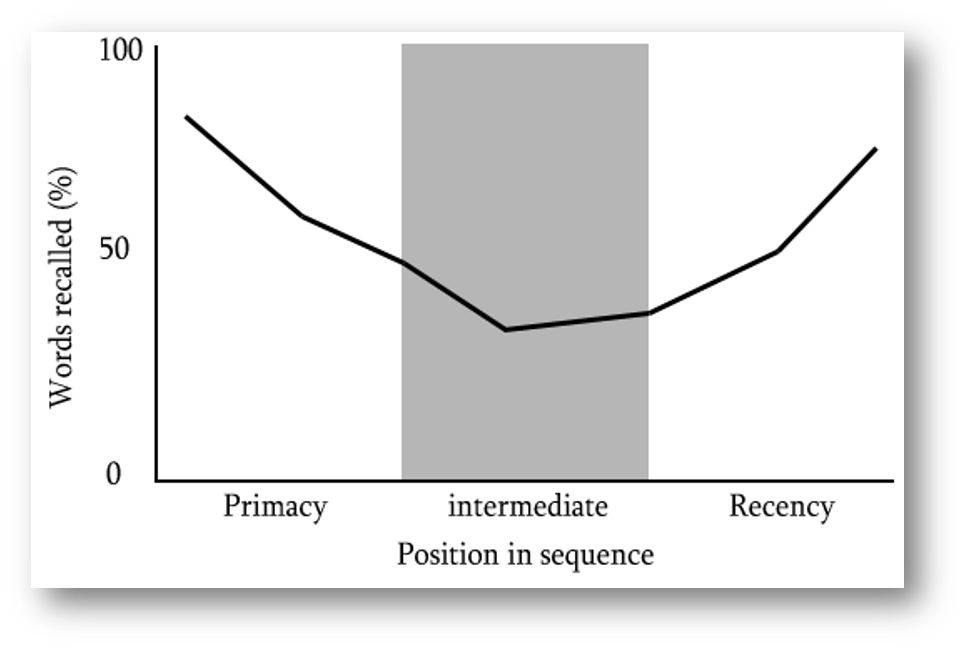
In a free recall task, the serial position effect is observed. This is a U-shaped curve where the first and last items are remembered better than the middle items. This effect has two parts:
- Primacy Effect: Early words are remembered better because they can be rehearsed more often. These words are more likely to move into long-term memory.
- Recency Effect: Last words are still in memory. This effect is reduced by adding a task during the retention interval.
Capacity of STM
Most people can retain about 7 items (plus or minus 2) in short-term memory. The capacity of STM is not about the amount of information but how it is grouped into "chunks".
Chunking
Chunking involves organizing information into manageable bits. A "chunk" is a collection of elements with strong associations to each other, but weak associations with other chunks. STM capacity is limited by the number of chunks.
- For example, the letters "PACKLOADFILL" can be chunked into three words which may be easier to remember than twelve individual letters.