Lecture 9: Other Models for Analyzing the Relationship Between Return and Risk


1. Arbitrage Pricing Theory (APT): Concept and Differences from CAPM

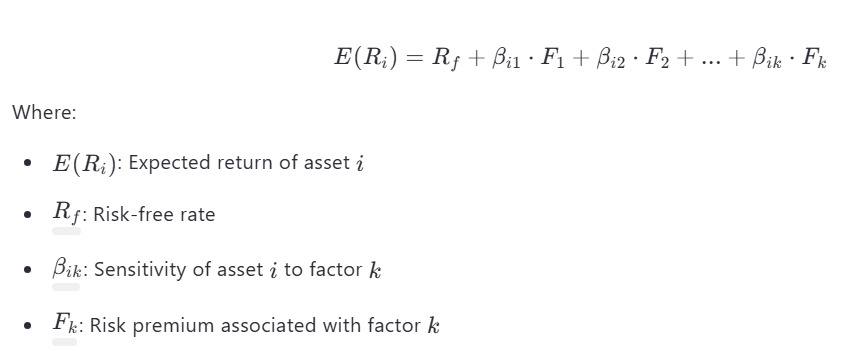
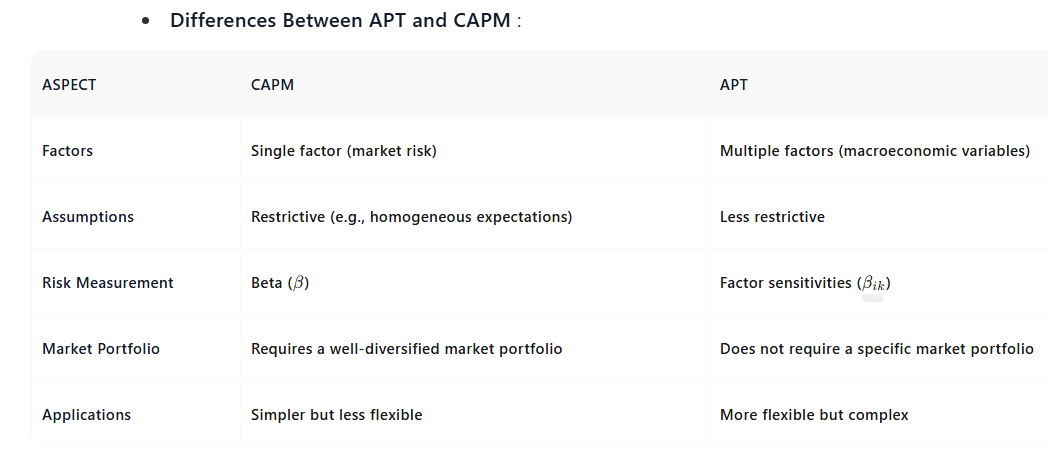
The Arbitrage Pricing Theory (APT) , developed by Stephen Ross in 1976, is an alternative to the Capital Asset Pricing Model (CAPM) for explaining the relationship between risk and return. Unlike CAPM, which is a single-factor model, APT is a multi-factor model that incorporates multiple sources of systematic risk.

 
  • Key Concepts of APT :

    • APT assumes that asset returns are influenced by multiple macroeconomic factors, rather than just market risk () as in CAPM.
    • The model does not require restrictive assumptions like homogeneous expectations or a single-period framework.
    • APT relies on the principle of arbitrage , where investors exploit mispriced assets to earn risk-free profits, driving prices back to equilibrium.
     
  • APT Formula :

2. Fama-French Three-Factor Model: Additional Factors

The Fama-French Three-Factor Model , introduced by Eugene Fama and Kenneth French in 1993, extends the CAPM by incorporating additional factors that explain variations in stock returns beyond market risk.

 
  • Additional Factors :

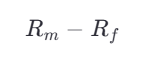
  1. Market Risk (MKT) :
    Similar to CAPM, this factor measures the sensitivity of an asset’s returns to market movements.
  1. Size Factor (SMB - Small Minus Big) :
    Captures the tendency of small-cap stocks to outperform large-cap stocks.

     
  2. Value Factor (HML - High Minus Low) :
    Reflects the tendency of value stocks (high book-to-market ratio) to outperform growth stocks (low book-to-market ratio).

    • Advantages of the Fama-French Model :

      • Provides a better explanation of stock returns compared to CAPM.
      • Accounts for anomalies like the size effect and value effect, which CAPM cannot explain.
     

    3. Comparison Between Different Models

    Model
    Factors
    Advantages
    Disadvantages
    CAPM
    Market risk ()
    Simple, easy to use, widely accepted
    Overly simplistic, ignores other risk factors, empirical inconsistencies
    APT
    Multiple macroeconomic factors
    Flexible, accounts for various risks, no reliance on a single market portfolio
    Complex, requires identification of relevant factors, difficult to implement
    Fama-French
    Market risk, size, value
    Explains anomalies like size and value effects, more accurate than CAPM
    Limited to three factors, may not cap

    4. Advantages and Disadvantages of Each Model

    CAPM :

    1. Advantages :
      1. Easy to understand and apply.
      2. Provides a clear relationship between risk and return.
       
    2. Disadvantages :
      1. Relies heavily on unrealistic assumptions.
      2. Ignores other risk factors beyond market risk.
      3. Empirical evidence shows limited explanatory power.
     

    APT :

    1. Advantages :
      1. Flexible and adaptable to different markets and conditions.
      2. Does not require a specific market portfolio.
      3. Can incorporate a wide range of risk factors.
       
    2. Disadvantages :
      1. Identifying and measuring relevant factors can be challenging.
      2. More complex and less intuitive than CAPM.
     

    Fama-French Three-Factor Model :

    Advantages :

    1. Explains anomalies like the size and value effects.
    2. Provides a better fit for historical stock return data.
     

    Disadvantages :

    Limited to three factors; may miss other important risks.

    Requires significant data and computational resources.


    5. Practical Implications

    Choosing the Right Model :

    1. CAPM is suitable for simple analyses or when data is limited.
    2. APT is ideal for complex portfolios or markets with diverse risk factors.
    3. Fama-French is useful for equity-focused portfolios and explaining anomalies.
     

    Combining Models :
    In practice, investors often combine insights from multiple models to gain a comprehensive understanding of risk and return. For example, APT can be used alongside Fama-French to capture both macroeconomic and firm-specific risks.


    Key Takeaways

    APT : A multi-factor model that explains returns based on multiple macroeconomic factors, offering greater flexibility than CAPM.

    Fama-French : Extends CAPM by adding size and value factors, providing a better explanation of stock return anomalies.

    Comparison : Each model has strengths and weaknesses, and the choice depends on the context and available data.

    Practical Use : Investors often use a combination of models to account for various risks and achieve a more accurate analysis of return and risk.

Last modified: Friday, 11 July 2025, 12:43 AM