
III.2.2 Process control block
Process states
When a process is running it changes states. The state of a process is defined in part by the current activity of that process. Each process can be in each of the states in the following figure.
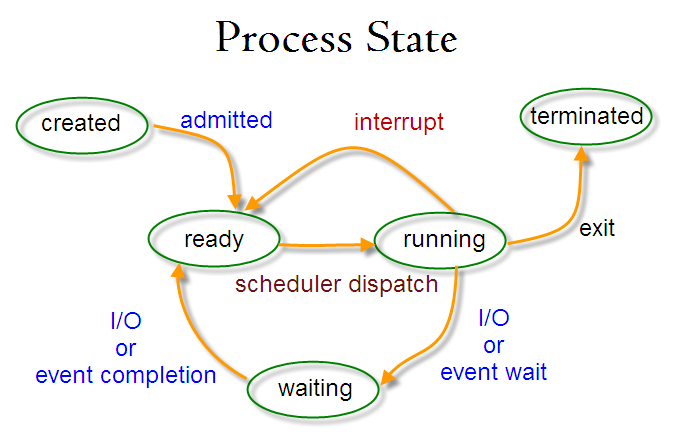
New/created : the process is being created,
Ready: The process can run as soon as it takes control of the processor. A process is in ready state if it has all the resources it is only waiting for the CPU resource. A process enters the ready state if the expected event occurs or if during execution the process found itself obliged to free the processor for the benefit of another process.
Running/executing: Process instructions are executing, only one process at a time can be in executing state.
Waiting/blocked: The process is waiting for an event to occur, this event is usually the completion of an I/O.
Terminated: state of a process which has finished its execution but whose information is kept by the OS (under Unix-like OS, we speak of a zombie process)
An OS maintains information about a terminated process if it has an I/O operation that finishes or if child processes of the latter are still running, etc.
NB: In Unix-like OS, a process can create child processes using either the SVC fork or exec). As well as, it can destroy them using the SVC kill.
III-2-3 Process control block
Each process is represented in the OS by a process control block (PCB). The PCBs of the processes created in the OS are grouped in the process table.
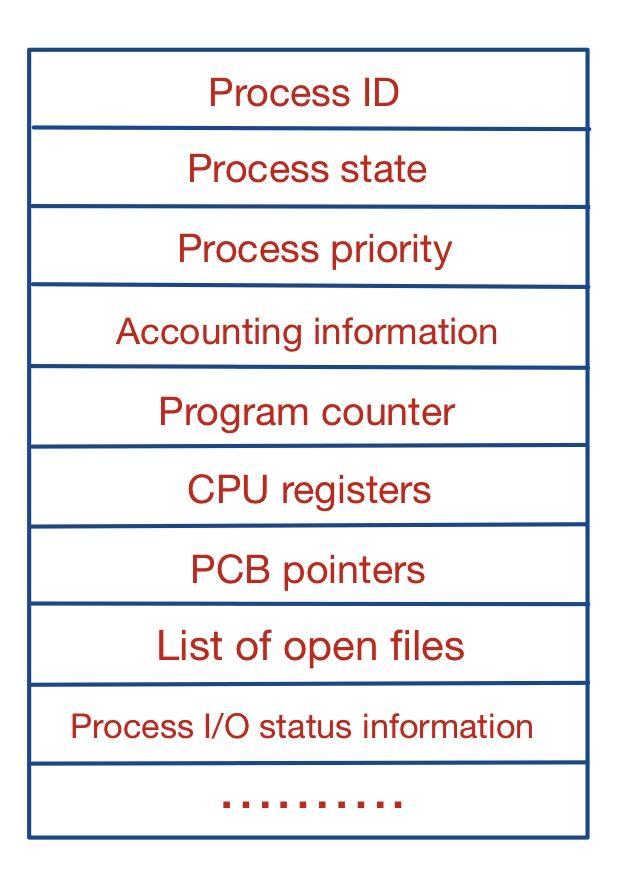
A PCB contains the information of a process including:
- the state of the process which can be new, ready, running, blocked or terminated,
- the instruction counter which indicates the address of the next instruction to be executed by this process,
- CPU registers: Registers vary in number and type depending on the architecture of the computer. This saved information makes it possible to resume the execution of a process following an interruption,
- CPU scheduling information: this information includes all scheduling parameters such as process priority and pointers to scheduling queues,
- memory management information: This information may include memory management information that pertains to the process. Such as base and limit registers, Memory pages and segments depending on the OS,
- accounting information: this information takes into account the amount of processor time, real time used, time limits, account numbers and job or process numbers,
- I/O status information: includes a list of I/O devices allocated to this process, a list of open files.