
1. Responsibility Matrices
A responsibility assignment matrix (RAM) maps the work of the project, as described in the WBS, to the people responsible for performing the work, as described in the OBS.
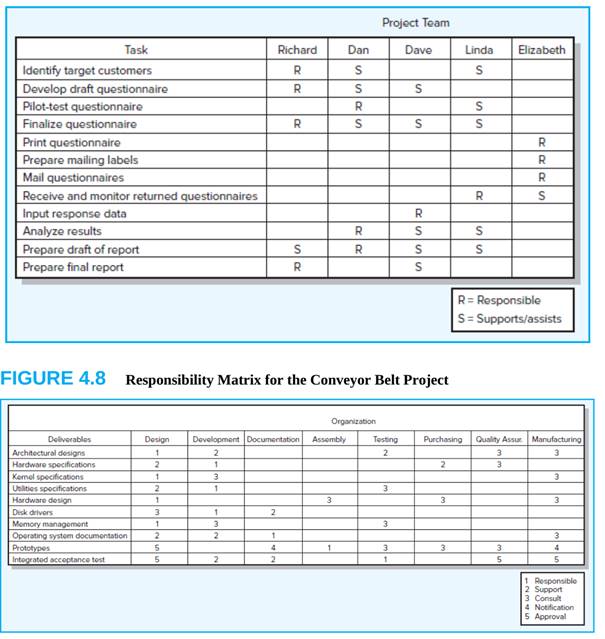
In many cases, the size and scope of the project do not warrant an elaborate WBS or OBS. One tool that is widely used by project managers and task force leaders of small projects is the responsibility matrix (RM). The RM (sometimes called a linear responsibility chart) summarizes the tasks to be accomplished and who is responsible for what on a project
Responsibility matrices provide a means for all participants in a project to view their responsibilities and agree on their assignments. They also help clarify the extent or type of authority exercised by each participant in performing an activity in which two or more parties have overlapping involvement. By using an RM and by defining authority, responsibility, and communications within its framework, the relationship between different organization units and the work content of the project is made clear.
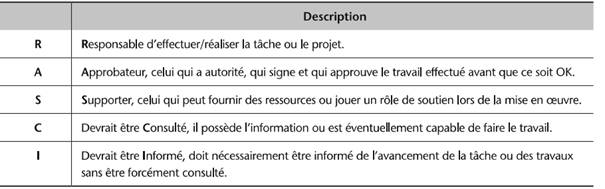
Some organizations use RACI charts to show four key roles
for project stakeholders:
• Responsibility: Who does the task?
• Accountability: Who signs off on the task or has authority for it?
• Consultation: Who has information necessary to complete the task?
• Informed: Who needs to be notified of task status and results?
a RACI chart lists tasks vertically and lists individuals or groups horizontally. Each intersecting cell contains an R, an A, a C, or an I. A task may have multiple R, C, or I entries, but there can be only one A entry per row to clarify wis accountable for each task.
La matrice est diffusée et mis à jour tout au long du projet.
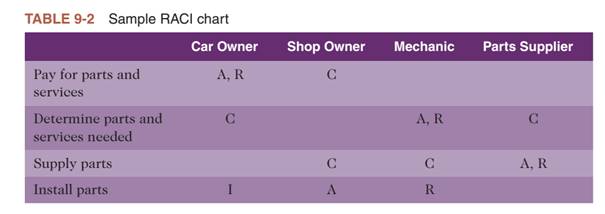
Fig 1 small project and fig 2 larghe project
2. Project Communication Plan
1. Once the project deliverables and work are clearly identified, creating an
internal communication plan is vital.
2. Poor communication is a major contributor to project failure.
3. The communication plan is usually created by the project manager
and/or the project team in the early stage of project planning.
4. Communication is a key component in coordinating and tracking project
schedules, issues, and action items. The plan maps out the flow of
information to different stakeholders and becomes an integral part of the
overall project plan.
5. The purpose of a project communication plan is to
express what, who, how, and when information will be transmitted to
project stakeholders so schedules, issues, and action items can be tracked.
Project communication plans address the following core questions:
· What information needs to be collected and when?
· Who will receive the information?
· What methods will be used to gather and store information?
· What are the limits, if any, on who has access to certain kinds of
· information?
· When will the information be communicated?
· How will it be communicated?
3. Developing a communication plan
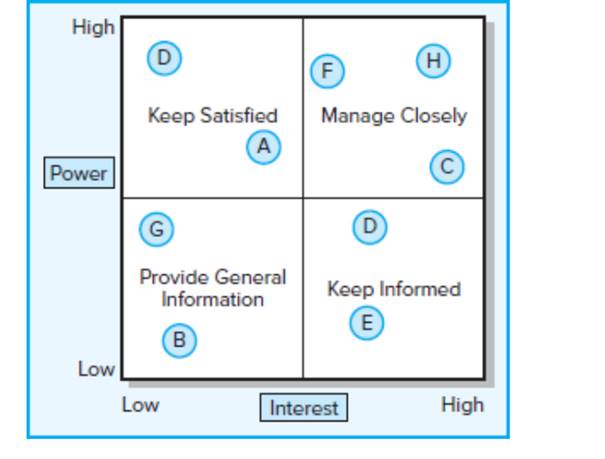
By identifying stakeholders and prioritizing them on the “Power/Interest” map, you can plan the type and frequency of communications needed.
Information needs. What information is pertinent to stakeholders who contribute to the project’s progress? The simplest answer to this question can be obtained by asking the various individuals what information they need and when they need it.
Frequent information needs found in communication plans are
Project status reports Deliverable issues
Changes in scope Team status meetings
Gating decisions Accepted request changes
Action items Milestone reports
Sources of information. When the information needs are identified, the
next step is to determine the sources of information. That is, where does
the information reside? How will it be collected? For example,
information relating to the milestone report, team meetings, and project
page 126
status meetings would be found in the minutes and reports of various
groups.
Dissemination modes. In today’s world, traditional status report meetings are being supplemented by e-mail, teleconferencing, SharePoint, and a variety of database sharing programs to circulate information. In particular, many companies are using the Web to create a “virtual project office” to store project information. Project management software feeds information directly to the website so that different people have immediate access to relevant project information. In some cases appropriate information is routed automatically to key stakeholders. Backup paper hardcopy to specific stakeholders is still critical for many project changes and action items.
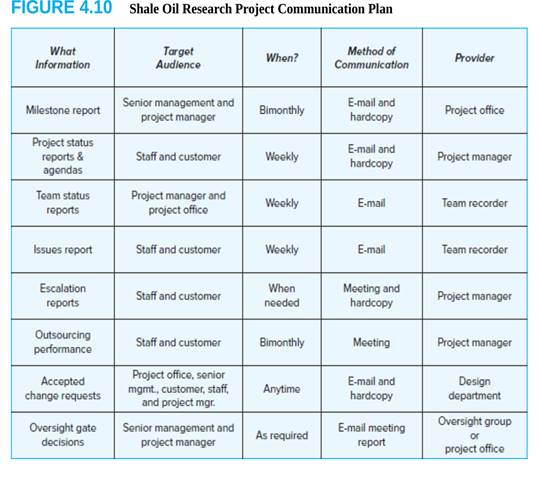
Responsibility and timing. Determine who will send out the information. For example, a common practice is to have secretaries of meetings forward the minutes or specific information to the appropriate stakeholders. In some cases the responsibility lies with the project manager or project office. Timing and frequency of distribution appropriate to the information need to be establishe