
1. Schedule Compression: Crash vs Fast Track
Algo
|
The general procedure for project crashing involves the following four steps: 1. Compute the crash cost per period for all activities using Equation 8-10. 2. Find critical path(s) in the project network using the normal times and identify critical activities. 3. Select a critical activity with the smallest crash cost per week that can still be crashed, in the case that there exists only one critical path. Otherwise, select one activity from each critical path that can be still crashed and yield the smallest total crash cost per period (including a common activity among critical paths). Crash the selected activity or activities by one period. Update the length of paths. 4. Stop the procedure if the completion deadline is reached. Otherwise, check to ensure current critical path(s) are still critical and find the new ones, if any. Return to Step 3. |
Schedule compression is a technique used in project management to shorten the overall timeline for a project without reducing the scope. This can be done using two approaches: crashing the schedule or fast-tracking the project or overtime.
-Although it will increase the cost of the project but in some cases, it is a good project strategy to be exercised when you’re forced to complete the project before time. T
Project managers turn to schedule compression techniques for many reasons, including the following:
- An unrealistic schedule
- Resources become unavailable after a specific date
- The emergence of unforeseen or unidentified risks
- Expedited product launch
- Changing client demands
- Force majeure
Fast-tracking: This is a technique in which project activities are performed in parallel so as to reduce the project time duration
Overtime: more working hours per day and/or more working days per week are used. But the productivity of resources declines with more working hours per day or more working days per week.
Project/schedule crashing
It is a technique used to shorten projects in which additional resources are used to reduce the normal time duration of a project. In the project crashing, the normal time durations of activities that lie on the critical path are shortened by using additional resources to decrease the overall project time duration
Project crashing is started by shortening the normal time duration of an activity lying on the critical path which has a lower crashing cost than other critical activities. This requires an understanding of the time and cost relationship of each activity.
2. TIME-COST RELATIONSHIP
The relationship between the total project cost and the time duration of a project must be established (see fig1). It is common practice to shorten the time duration of a specific project so that the saved time may be used for other projects, allowing the organization to earn more profit.
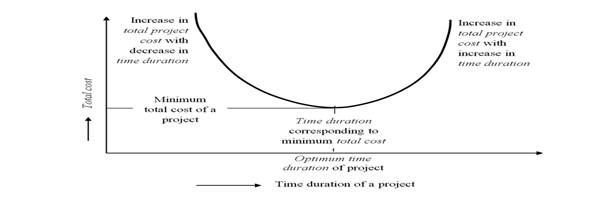
Fig 1 Relationship of total project cost to project time duration
1. executing an activity according to its normal time duration, the cost is assumed to be at its minimum. The execution of the same activity within a time duration shorter than the normal time duration increases its execution cost.
2. In CPM, there are two cost estimates associated with each activity: a normal cost estimate and a crash cost estimate.
In CPM, the relationship between the total project cost and the time duration is taken to be as shown in Figure 1. The time duration corresponding to the minimum total project cost of a project is called the optimum time duration of a project.
The objective is to find the project time duration which corresponds to the minimum total project cost. The optimum time duration is assumed to offer the most economic project execution cost.
3. Constituents of Total Project Cost
direct cost
The direct costs of a project are generally related to individual activities.
direct cost of project execution (Direct costs of an activity include worker costs, material costs, and equipment costs+ government fees, legal fees, or consultation fees) and indirect cost related to the project.
-If cost is not a constraint, adding more resources to the project might reduce the time duration i.e., time is inversely proportional to cost (see fig 3 The direct cost curve
).
- normal time =The time for the activity at minimum cost (normal cost) (the focus is on the minimum cost of an activity)
- crash time =the minimum time for the activity (crash cost)
- A crash time duration is the time below which an activity cannot be shortened by any further increase in resources. 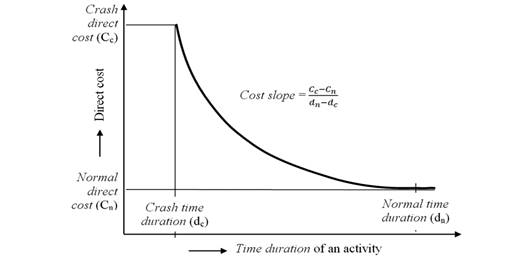
Fig3. Time cost relationship (Increase in the direct cost of an activity with decrease in time).
The direct cost curve shown in Figure 4 may be approximated by more than one straight line (segmented approx.) or by a single straight line (linear approx.) depending upon the flatness of the curve. Figure 4.
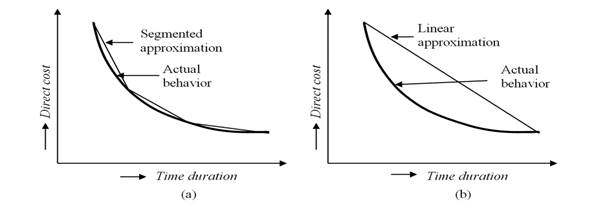
Fig 4. Direct cost: (a) segmented approximation of direct cost and (b) linear approximation of the direct cost.
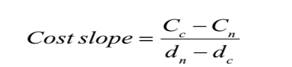
Segmented or straight-line approximation of a direct cost curve is used to carry out a project cost analysis by determining the value of the cost slope. The cost slope is the slope of the direct cost curve, approximated as a straight line.
Straight-line approximation gives a single value for the cost slope; segmented approximation of a direct cost curve, on the other hand, gives more than one values for the cost slope (more accurate) analysis.
Total Indirect Cost : s. Indirect costs are determined for a project as a whole, hence the name total indirect cost (Cela inclut les dépenses liées aux frais administratifs du projet, aux frais de mise en place du projet, aux frais généraux du projet, aux coûts de supervision, aux réclamations d'assurance, aux coûts d'accidents, aux autres pénalités, etc. ). Les frais généraux du projet comprennent le coût des voitures et camions attribués à l'équipe du projet, les coûts des bureaux de chantier, les coûts de construction des structures temporaires, les coûts des équipements de bureau (photocopieuses, ordinateurs, imprimantes, etc.), les coûts des services publics (eau potable, téléphones, gaz, toilettes, etc.), etc. Le coût indirect total augmente avec la durée du projet. La relation générale entre le coût indirect total et la durée du projet est non linéaire et elle est illustrée à la Figure 2.
La relation entre le coût indirect total et la durée d'un projet est approximée par une ligne droite, dont la pente est considérée comme égale aux dépenses par unité de durée du projet. Les coûts directs diminuent lorsque la durée augmente, tandis que les coûts indirects totaux augmentent lorsque la durée d'un projet s'allonge.
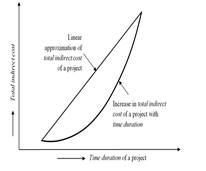
Fig 2 Increase in the total indirect cost of a project with an increase in time duration
4. Total Project Cost and Optimum Time Durations
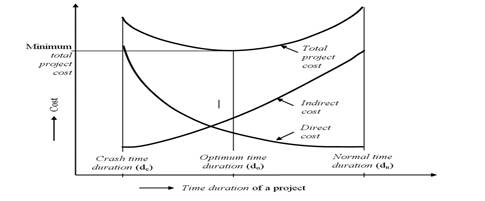
A total project cost = direct costs + indirect cost of a project.
Figure 6 shows the direct cost curve, indirect cost curve, and total project cost curve of a project.
1. The minimal total project cost is reached in a span of time called the optimum time duration (do ).
2. With a further increase in the project time duration, the total project cost will increase, while with a further decrease in the project time duration, the total project cost will again increase.
3. The decrease in the project time duration to the minimum time duration required to execute a project attains what is called the project crash time duration (dc ). At the project crash time duration project costs reach their highest, and this is called the project crash cost (Cc ).
5. Steps involved in project crashing as follows;
1. Identify critical path and critical activity
2. Compute crash cost slope i.e. [(Crash cost – Normal cost) / (NormalTime – Crash Time)]
3. Select the activity with the least cost slope i.e., minimum crash cost per
unit time.
4. Check for the critical path.