
1.
1. Introduction
Romanticism was a literary, artistic, and intellectual movement that began in the late 18th century and reached its height in the early 19th century, primarily in Britain, France, and Germany. In English poetry, Romanticism represented a break from the earlier Age of Enlightenment, which had emphasized reason, order, and classical restraint. This movement marked a dramatic shift in the way poets viewed the world, human emotion, and the role of art in society.
2
1. Defining Romanticism
The word "romantic" can be used to describe love stories in any culture or time period, while the word "Romantic" with a capital "R" describes a literary movement from the 18th and 19th centuries. The Romantic period, also known as Romanticism, was an intellectual, artistic, and literary movement that took place in Europe and America around 1780-1850. European Romanticism began as a reaction to the ways in which the Industrial Revolution and the Enlightenment had transformed society.
The Enlightenment had prioritized reason and rationality over emotion and creativity. The Industrial Revolution had urbanized England. Technology was booming, science was accelerating, and cities were becoming increasingly crowded. As a result of these changes, many people felt like humanity was losing its relationship with the natural world and the sublime Along came the Romanticists: a group of artists, writers, and intellectuals who celebrated nature, emotion, and the spiritual. They criticized the way society had changed and glorified the past in their work.
3. Historical and Cultural Context:
The rise of Romanticism can be understood through the historical context of the late 18th and 19th centuries. The Industrial Revolution, which brought rapid industrialization to Britain, led to significant social changes, including urbanization, the growth of factories, and the erosion of rural life. Many Romantic thinkers were troubled by the dehumanizing effects of industrialization and sought solace in nature, seeing it as a pure and spiritually renewing force. Additionally, the French Revolution and the Napoleonic Wars profoundly influenced Romantic poets, who were inspired by the ideals of liberty, equality, and fraternity, though the violence and instability that followed led to disillusionment. In Britain, political unrest and calls for reform further fueled the desire for social and political change. Romanticism also emerged as a reaction against the Enlightenment's emphasis on reason, science, and rationality, with poets seeking to break free from these intellectual constraints and instead embracing emotion, intuition, and the creative power of the imagination.
4. Characteristics and Features of Romanticism:
Romanticism was not a single style but a complex and diverse set of beliefs, ideals, and artistic expressions. However, there are several key themes that recur throughout Romantic poetry:
- Emotion and Individualism: Romantic poets celebrated the power of emotion and the individual’s inner life. They emphasized feelings over reason and sought to explore deep, personal, and often turbulent emotions such as love, awe, despair, and longing.
- Nature: Nature was central to Romantic poetry. Romantics believed that nature was a source of inspiration, spiritual renewal, and solace. It was often seen as a reflection of human emotions and a place of freedom and escape from the constraints of society and industrialization.
- Imagination: For Romantic poets, imagination was more important than reason. It was seen as a creative and transformative power that allowed the poet to see beyond the ordinary world and into the realms of the sublime and the spiritual.
- The Sublime: The Romantics were fascinated by the concept of the sublime—the overwhelming, awe-inspiring power of nature, which could evoke both beauty and terror. Mountains, storms, and vast oceans were often seen as symbols of the sublime in their poetry.
- Rebellion Against Tradition: Romantic poets often rebelled against the established literary traditions, especially the rigid forms of the neoclassical period. They experimented with language, form, and themes, embracing freedom and innovation.
· Emotion and passion : The Romanticists were deeply in touch with their feelings. Emotion was one of the most crucial characteristics of the Romantic period. Wordsworth said that poetry began as “the spontaneous overflow of powerful feeling: it takes its origin from emotion recollected in tranquility.” This statement perfectly captures the way that many Romanticists saw emotion as a driving force for art.
· The critique of progress : Romanticists viewed urbanity and industrialization in a largely negative light. Many Romantic authors understood the importance of progress, but criticized the way it impacted the common people.
· A return to the past : Related to their critique of progress is the fact that Romanticists were fascinated with the past and resurrected it in various forms. They used their writing to remind everyone of what the past had to offer and how far society had moved away from the good old days.
5. Major Poets of the Romantic Period:
There are Two generations of Romantic English poets,
The first generation of English Romantic poets often referred to as the "Lake Poets" or simply the pioneers of Romanticism, includes, William Wordsworth (1770-1850), Samuel Taylor Coleridge (1772–1834), and Robert Southey (1774–1843), laid the foundation for the movement in the late 18th and early 19th centuries, focusing on nature, emotion, the imagination, and the lives of ordinary people. Wordsworth's reverence for nature and Coleridge's exploration of the supernatural set the tone for Romanticism, while Southey contributed with his long narrative poems.
The second generation, (often referred to as the "Byronic" or "Satanic" poets) came to prominence in the early 19th century, roughly around the 1810s to 1820s. They are seen as a continuation of the Romantic movement, but their works tend to emphasize darker themes, personal rebellion, political and social critique, and individualism. The second generation is notably more intense and emotionally charged than the first. Led by Lord Byron, Percy Bysshe Shelley, and John Keats, took these themes further, introducing darker, more intense elements, such as rebellion, individualism, and the quest for transcendence. Byron's Byronic hero, Shelley's radical political views, and Keats's meditations on beauty and mortality marked a shift towards personal tragedy and idealism. Both generations shaped the movement's legacy, influencing later literature with their emphasis on emotion, the individual, and the power of nature and imagination.
Conclusion:
Romanticism in English poetry represents a profound shift in how poets viewed the world and their role in it. By embracing emotion, imagination, and the natural world, the Romantics created a new poetic vision that rejected the confines of reason and tradition. Through their work, they explored the depths of human experience, both light and dark, and helped shape the future of English literature.
Summary
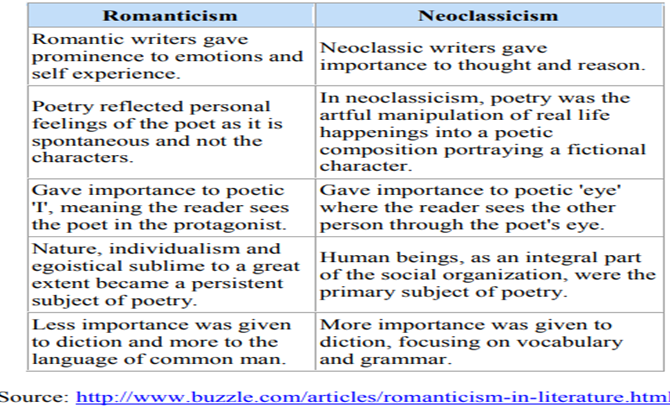
We have said previously that Romanticism was a reaction against Neoclassicism. It would suffice, as a way of summary to highlight the differences between Romanticism and Neoclassicism for a better understanding of this movement.
References for Further Reading
Dahiya, B.S. A New History of English Literature. New Delhi: Doaba Publications. Nayar, Pramod K. A Short History of English Literature. Bangalore: Cambridge University Press, 2009. Print. Rogers, Pat. The Oxford Illustrated History of English Literature. New York: OUP, 1987. Print.