
D R M O U L A Y T A H A R U N I V E R S I T Y O F S A I D A F A C U L T Y O F N A T U R A L A N D L I F E S C I E N C E S
D E P A R T M E N T O F B I O L O G Y
A C A D E M I C Y E A R 2 0 2 4 - 2 0 2 5
T h e f o u n d a t i o n s a n d p i l l a r s o f a c a d e m i c s u c c e s s :
T D S h e e t N ° 3
Definitions:
- The scientific method: is the set of rules and procedures to follow to achieve objectives and to conduct scientific research.
According to Jean Louis LAUBET Del Bayle, 2010 the method is defined “As the set of intellectual operations allowing the analysis, understanding and explanation of the reality studied”.
- The scientific approach: is an intellectual path that organizes scientific activity. Also these are the set of steps to follow to carry out scientific research. (This is the way to progress towards the goal or subject outlined).
- Methodology: is the science of method.
Methodology: it is all the methods and approaches in a particular field, adopted by specialists such as researchers, publishers, teachers, etc. to carry out scientific research.
- Research is:
- The action of searching in various fields.
- A search for facts or truth about a subject.
- An organized investigation to solve problems, test hypotheses, or invent new products.
- Research is a systematic and methodical exercise in the study of any problem. (Bruno D, 1994).
- Research is an effort to find something or an effort of the mind toward knowledge. (Le Grain M, 1994).
- The research requires:
- Effort.
- Time.
- Continuity.
- Courage
- Types of research: example:
 Scientific research: type of research whose interest is more public than private.
Commercial research: type of research whose interest is more private than public.
- Science is:
- A method for grasping reality;
- All knowledge;
- A set of standards;
- A methodology.
- Technique: is the set of tools, instruments and means specific to an activity or research.
- The different stages of scientific research:
To carry out scientific research, it is advisable to follow the following steps (process)
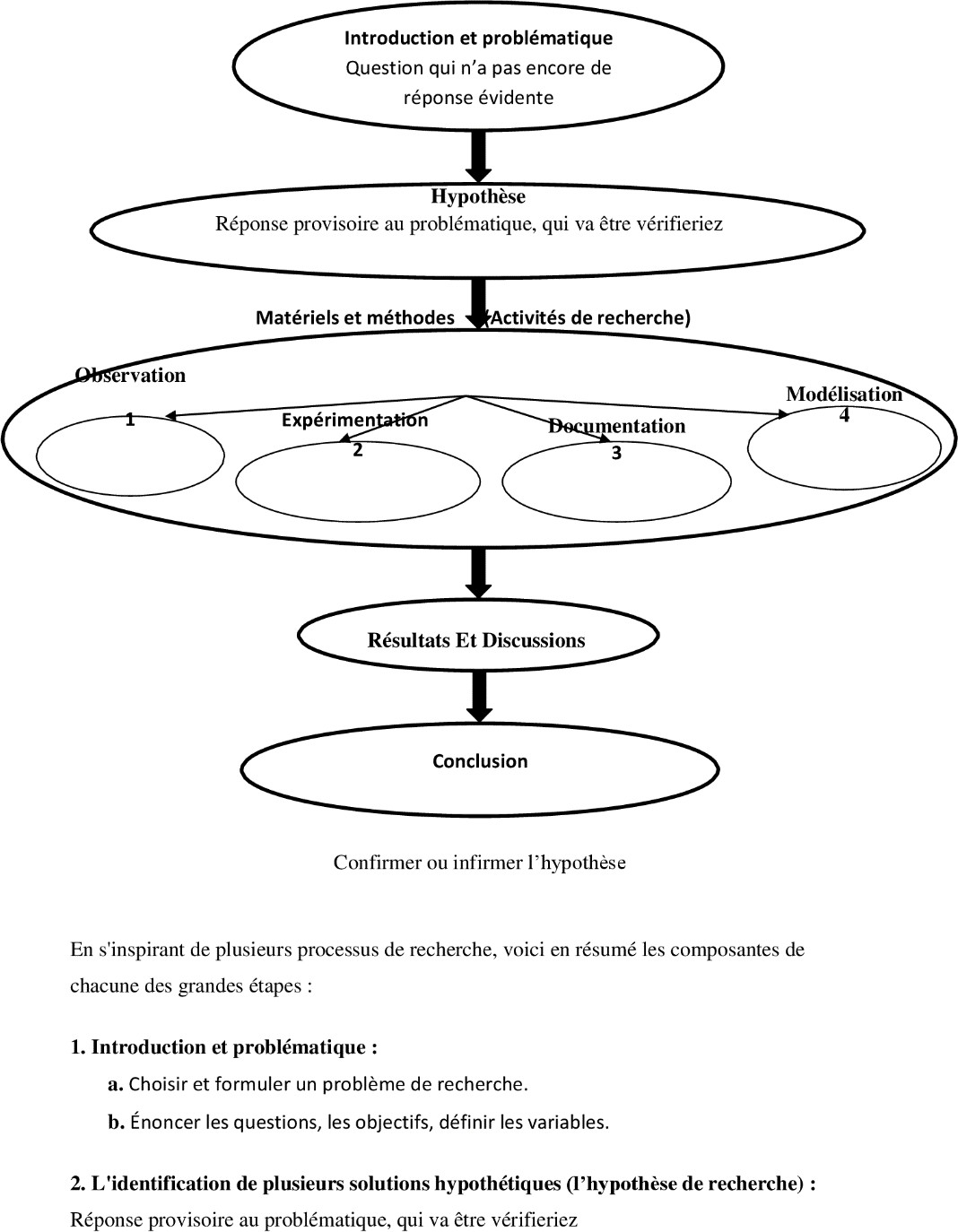
Drawing inspiration from several research processes, here is a summary of the components of each of the major stages:
- Introduction and issues:
- Choose and formulate a research problem.
- State the questions, the objectives, define the variables.
- Identification of several hypothetical solutions (the research hypothesis): Provisional response to the problem, which will be verified
- Materials and methods (Research activities)
- The research activity can be done in four (4) different ways depending on the research field:
- By Observation: widely used in biology or astronomy. It is an analytical process.
- By Experiment: widely used in physics. It has obvious limits in the study of life (ethics, often difficult separation of variables, etc.).
- By Documentation: suitable for all disciplines but you must think about the difficulties of reading the texts and images contained in the documents.
- By Modeling: modeling consists of replacing the overly complex reality with a diagram, a model, an organization chart, etc. to respond to the problem posed. widely used in architecture and civil
engineering….
- Results and Discussions:
- Interpret/discuss the results (verify the authenticity of the results obtained, the hypotheses, question the theories, develop them, etc.)
- Carrying out the diagnosis.
- Conclusion:
- Evaluation of the research carried out.
- Confirmation or refutation of the proposed hypothesis.
- Role of research:
- Get rid of prejudices;
- Articulate information;
- Analyze situations;
- Give better explanations of facts and realities;
- Construct reflections;
- Be in development.
- The basic principles of scientific research:
- Positivism: it refers to the set of methods and theories used to break down false information that gives us the illusion of understanding things.
- Constructivism: it is research work that is based on logic.
- The observation: these are the results obtained according to the research carried out.