-
3) Teaching Reading
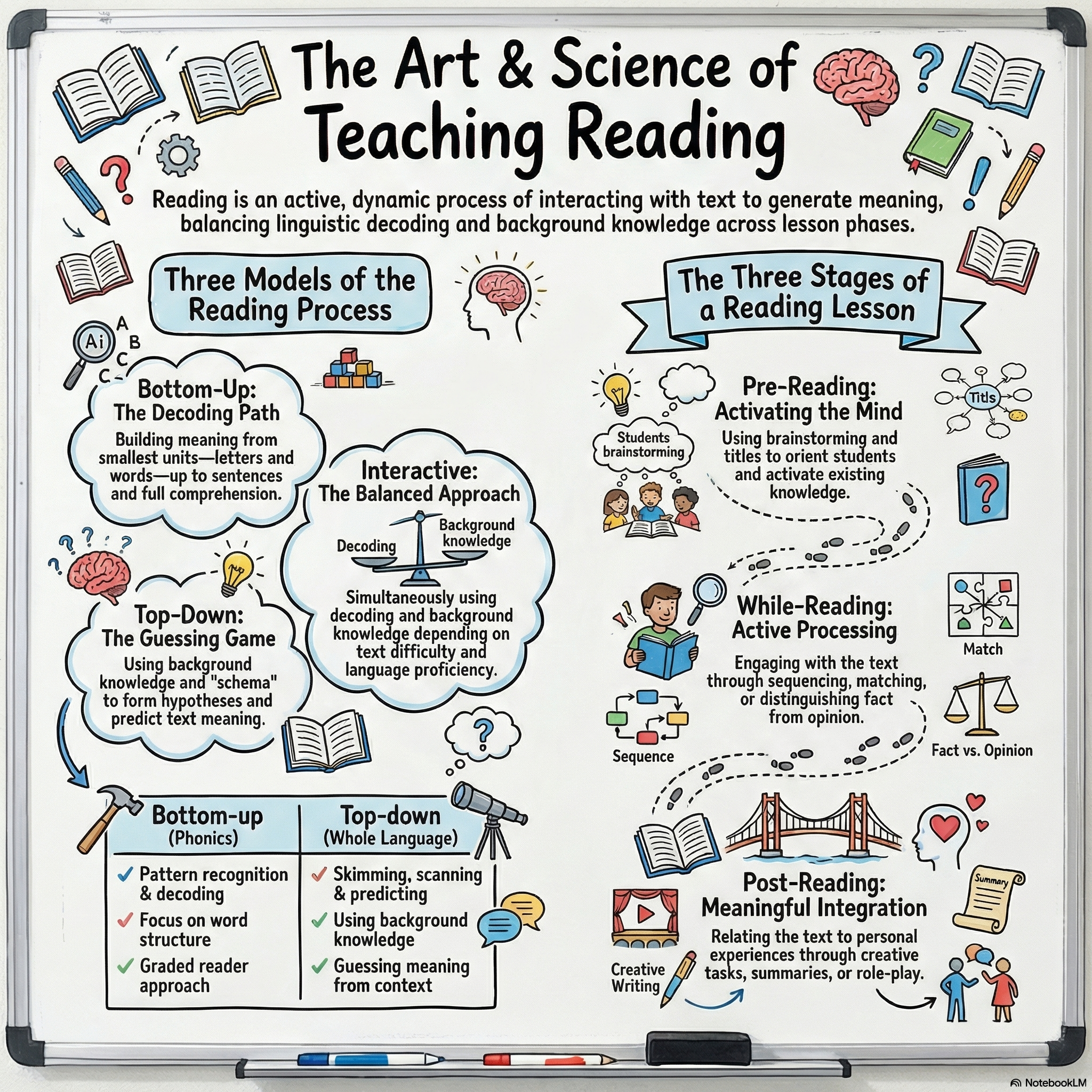
The lesson defines reading as an active, dynamic process where readers interact with a text to generate meaning by combining linguistic information with their own background knowledge. It examines three cognitive models—bottom-up, top-down, and interactive—and details how effective readers adjust their strategies, such as skimming and scanning, based on their specific purpose and the genre of the text. In this lesson we provide a structured framework for instruction, dividing reading lessons into pre-reading, while-reading, and post-reading stages to activate schema, practice active processing, and integrate new language. Finally, the lesson contrasts intensive and extensive reading approaches, emphasizing that teaching should focus on developing practical skills and strategies through authentic tasks rather than simply testing comprehension.

At the end of Lecture 3, students will be able to:
- Define reading.
- Compare and contrast the three models of reading: the bottom-up model (moving from the smallest units like letters to meaning), the top-down model (a "psycholinguistic guessing game" based on predictions and schema), and the interactive model (the simultaneous or alternate use of both).
- Analyze how different text genres and reading purposes—such as reading for pleasure, information, or to follow instructions—influence the specific reading strategies and styles a reader chooses to employ.
- Identify and apply the strategies used by effective readers.
- Design a structured three-stage reading lesson consisting of pre-reading (activating schema and establishing purpose), while-reading (practicing active strategies and modeling the process of understanding), and post-reading (integrating skills and relating the text to personal feelings or other knowledge).
- Differentiate between intensive and extensive reading approaches, recognizing that intensive reading focuses on thorough classroom study for skill practice, while extensive reading involves reading large quantities of self-chosen material for general comprehension.
-
Lecture 3
-
Summary Video
-
Summary Post
-
References
Aebersold, J. A., & Field, M. L. (1997). From reader to reading teacher: Issues and strategies for second language classrooms. Cambridge University Press.
Gebhard, J.G. (1996). Teaching English as a Foreign Language: A Teacher Self-Development and Methodology Guide. Ann Arbor: The University of Michigan Press.
Gibbons, P. (2002). Scaffolding language, scaffolding learning: Teaching second language learners in the mainstream classroom . Portsmouth, NH: Heinemann.
Goodman, K. (1970). Reading as a psychologistic guessing game. In H. Singer and R. b. Ruddell . (Eds). Theoretical models and Processes of Reading. Newark, N.J.: International reading Association.
Hedge, T. (2001). Teaching and learning in the language classroom (Vol. 106). Oxford,, UK: Oxford University Press.
Rivers, W. M., & Temperley, M. S. (1978). A Practical Guide to the Teaching of English as a Second or Foreign Language. Oxford University Press, 200 Madison Ave., New York, NY 10016.
Munby, J. (1978). Communicative syllabus design: a sociolinguistic model for defining the content of purpose-specific language programmers. Cambridge University Press.
