-
5) Teaching Speaking
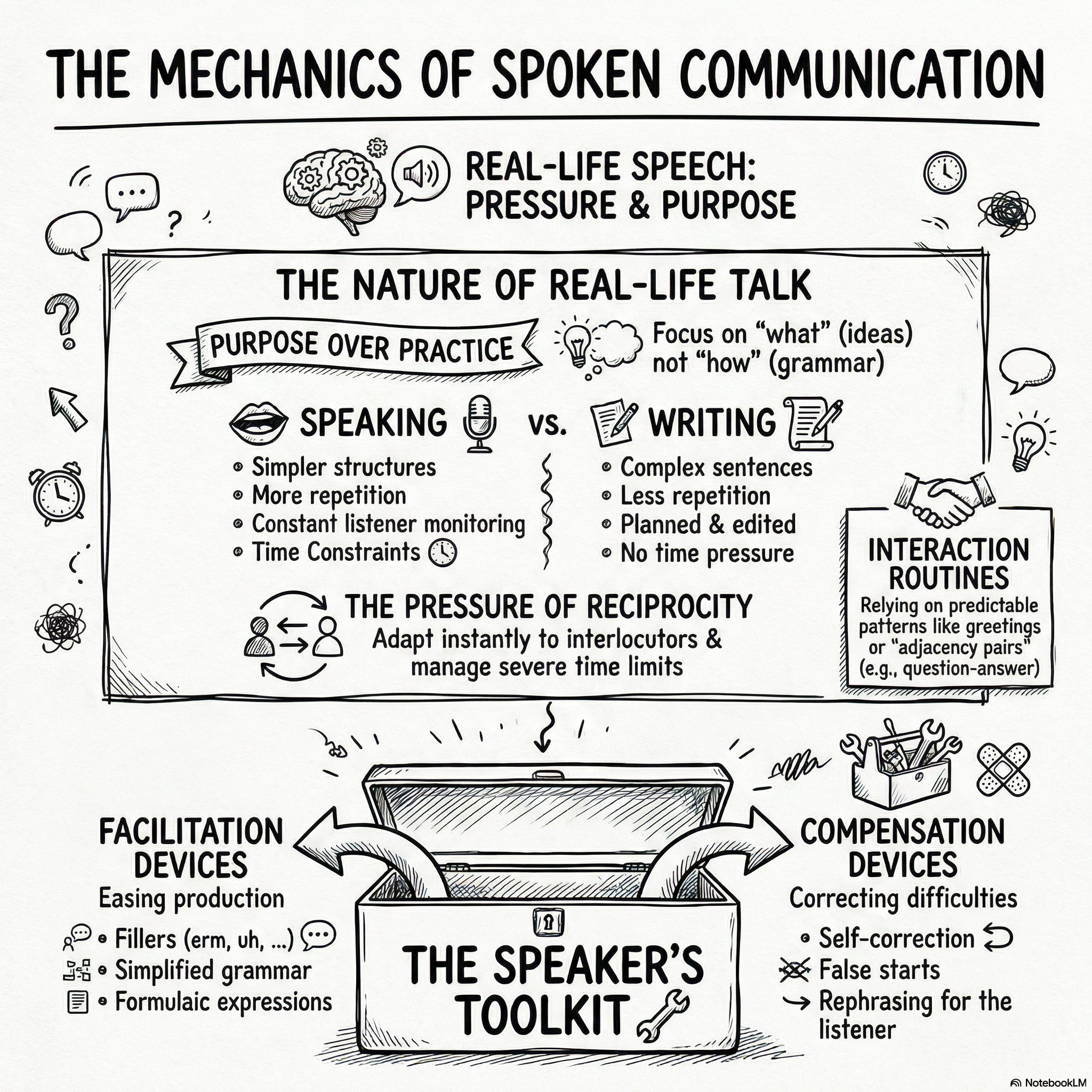
This lesson explores speaking as a complex, real-time communicative skill that requires speakers to produce appropriate utterances under significant time and reciprocity constraints. It details the linguistic features of speech, such as facilitation devices like fillers and compensation devices like self-correction, which help speakers maintain fluency during spontaneous interaction. The lesson examines a variety of classroom activities—from controlled drills to creative simulations—aimed at developing interaction skills such as turn-taking, management of adjacency pairs, and communication strategies. Finally, it identifies common learner challenges like inhibition and provides teachers with practical strategies, such as group work and careful task selection, to ensure high motivation and even participation.

At the end of Lecture 5, students will be able to:
- Explain the nature of real-life communication, specifically how it is driven by a need to convey ideas rather than just practicing language, resulting in varied grammar and vocabulary.
- Analyze the challenges of spontaneous speech, including the processing conditions (time pressure) and reciprocity conditions (the need to monitor the listener's reactions) that affect fluency and planning.
- Contrast speaking and writing, identifying how the presence of a live listener leads to shorter, less complex sentences, frequent repetition, and the need for interactive structures.
- Identify and apply linguistic devices used in speech, such as facilitation devices (fillers, ellipsis, and simplified structures) and compensation devices (self-correction and rephrasing) to manage the pressure of real-time production.
- Demonstrate interaction management skills, such as turn-taking, interrupting, topic-shifting, and the use of adjacency pairs (e.g., invitations and their responses).
- Differentiate between classroom activity types.
- Address common learner obstacles, such as inhibition, lack of interest, and uneven participation.
- Implement teacher best practices for facilitating activities, including careful topic selection, pre-teaching essential vocabulary, and providing feedback after the activity to avoid interrupting the flow of communication.
-
Lecture 5
-
Watch this to get the gist of the lesson
-
Summary Post
-
References
Johnson, Keith (1981). Interaction: Some Background, Some key terms and some definitions, in: Keith Johnson-K. Morrow (ed.), Communication in Classroom. London Longman, 1-12.
