-
6) Teaching Writing
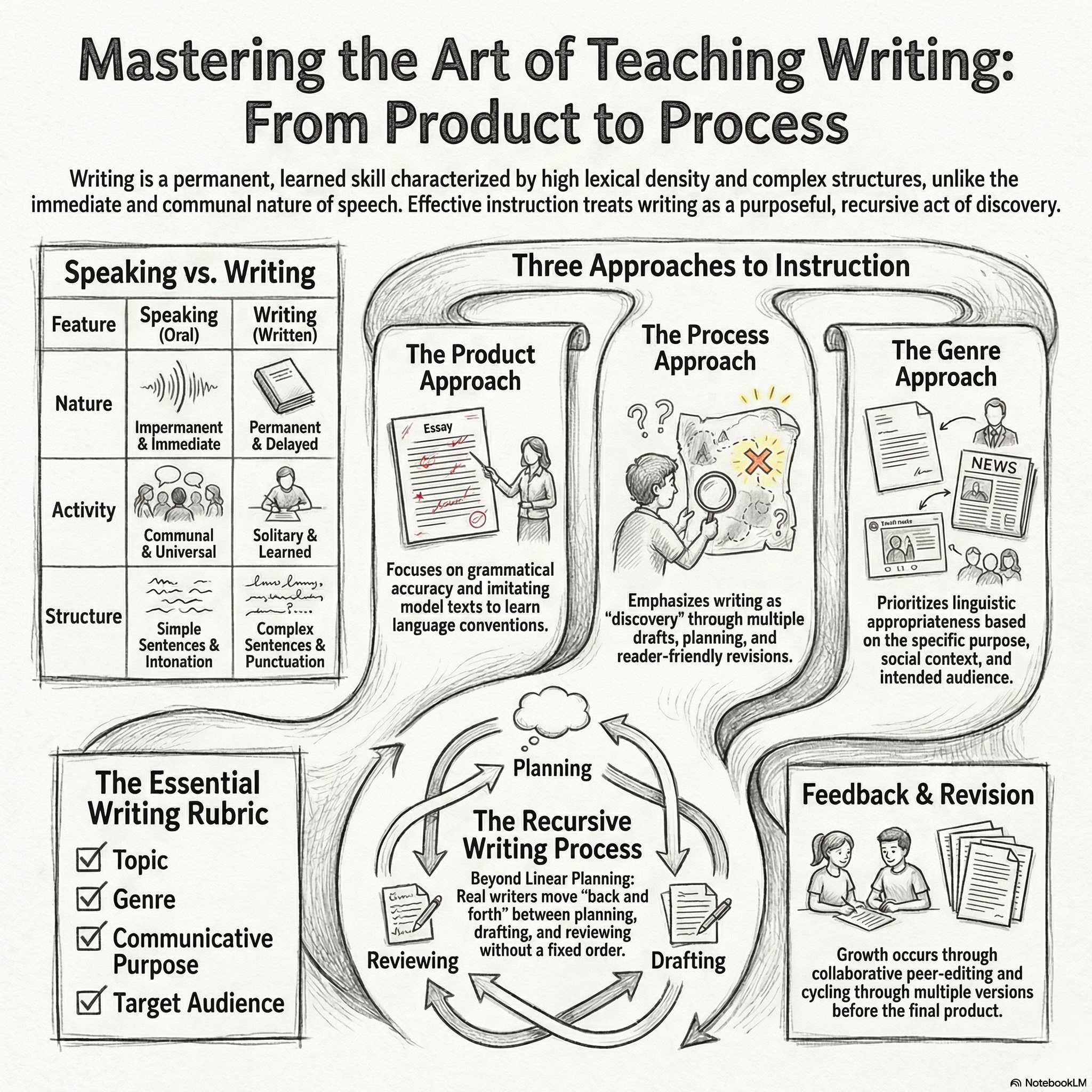
The lesson defines writing as a permanent, planned, and solitary activity that serves as a vital tool for building linguistic fluency and making thinking evident. It identifies four essential types of knowledge required for writing—language, topic, audience, and stored writing plans—and details how clear prompts should specify a task's genre and communicative purpose. The lesson contrasts three primary teaching methodologies: the product approach, which focuses on grammatical accuracy; the process approach, which emphasizes recursive drafting and revision; and the genre approach, which analyzes linguistic appropriateness for specific contexts. Finally, it highlights the importance of motivating students through authentic, creative tasks and providing constructive feedback throughout the writing process.

At the end of Lecture 6, students will be able to:
- Contrast the fundamental characteristics of written and oral language.
- Articulate the pedagogical importance of writing, recognizing it as a way to make thinking evident.
- Identify the four essential types of knowledge required for writing, which include knowledge of language (mechanics and discourse types), knowledge of the topic, knowledge of the audience, and stored writing plans (both formal and content schemata).
- Evaluate and design effective writing prompts (rubrics) that clearly define the topic, genre, communicative purpose, target audience, and specific features expected in the student's output.
- Differentiate between the three primary methodological approaches to writing.
- Categorize various text types—such as personal, public, creative, social, study, and institutional writing—to select appropriate tasks for different learner levels and needs.
- Implement strategies to motivate student writers.
- Apply best practices for writing instruction, such as analyzing model texts before writing, emphasizing multiple drafts, and encouraging students to perform their own proofreading at the end of the process.
-
Lecture 6
-
Watch this
-
Methodological Approaches and Characteristics of Teaching Writing
Approach or Category Key Characteristics Core Focus Typical Activities Advantages or Strengths Drawbacks or Limitations Target Outcomes Product Approach Dominated until the 1980s; views writing as a linear transcription of language; emphasizes sentence-level accuracy and copying model texts. Grammatical accuracy, correct vocabulary usage, and the consolidation of linguistic structures (e.g., Past Simple). Reading model texts; performing grammar exercises; transforming sentences or tenses based on models. Consolidates grammar and vocabulary; provides clear metrics for assessing student progress in language learning. Neglects clear communication of ideas and genre characteristics; often restricted to isolated end-of-unit homework. Linguistic accuracy and the successful completion of a specific written product. Process Approach Views writing as a recursive, messy process of discovery; emphasizes that writing is fundamentally a cycle of rewriting. The stages of composing (planning, drafting, revising, editing) and the communicative purpose of the text. Brainstorming; multiple drafting; peer editing; gathering information; goal setting; reader-friendly revisions. Develops awareness of the nature of writing; builds research and collaboration skills; provides continuous feedback loops. Highly time-consuming; can lead to loss of student interest; may restrict spontaneity and not suit all personalities. Development of effective writing habits and clear communication of thoughts to a specific audience. Genre Approach Focuses on how writers use language to respond to recurring situations; texts vary linguistically based on purpose and context. Linguistic appropriateness to the intended purpose; analysis of typical organization, grammar, and vocabulary of specific text types. Analyzing model texts; comparing texts with different structures; reorganizing scrambled paragraphs; completing cloze tasks. Explicitly teaches students the conventions of different genres; highly effective for English for Specific Purposes (ESP). Can be overly prescriptive; imitating styles may limit the original creativity of the student. Production of texts that are socially and linguistically appropriate for specific communicative events. Principles for Effective Instruction Pedagogical guidelines designed to motivate students and improve writing skills through structured support. Clear purpose, audience awareness, authenticity, and the provision of constructive feedback. Collaborative group writing; pre-writing preparation; sharing work with peers; strategic treatment of errors. Increases student motivation; provides a sense of achievement; helps students experience success in writing. Requires extensive teacher preparation and the trial of tasks before classroom implementation. Development of communicative competence and creative expression. Writing Task Categories Classification of writing based on the social or functional domain of the specific task. Diversity of writing applications in real life (Personal, Public, Creative, Social, Study, Institutional). Writing diaries, letters of complaint, poems, invitations, lecture notes, or business contracts. Provides variety in the classroom; helps students understand different contexts and diverse audiences. Textbook tasks often lack the authentic sense of audience found in real-world categories. Ability to handle various real-world writing requirements effectively. -
References
Flower, L., & Hayes, J. R. (1981). A cognitive process theory of writing.College composition and communication, 365-387.Hairston, M. (1982). The winds of change: Thomas Kuhn and the revolution in the teaching of writing. College composition and communication, 76-88.
Hyland, K. (2004). Disciplinary discourses: Social interactions in academic writing. University of Michigan Press.
Hyland, K. (2008). Writing theories and writing pedagogies. Indonesian Journal of English Language Teaching, 4(2), 91-110.
Ivanič, R. (2004). Discourses of writing and learning to write. Language and education, 18(3), 220-245.
National Writing Project & Nagin, C. (2003). Because Writing Matters: Improving Student Writing in Our Schools. San Francisco, CA: JosseyBass.
Paltridge, B. (2001). Genre and the language learning classroom. Ann Arbor: University of Michigan Press.
Swales, J. (1990). Genre analysis: English in academic and research settings. Cambridge University Press.
Zamel, V. (1983). The composing processes of advanced ESL students: Six case studies. TESOL quarterly, 17(2), 165-188.
-