-
4) Teaching Listening
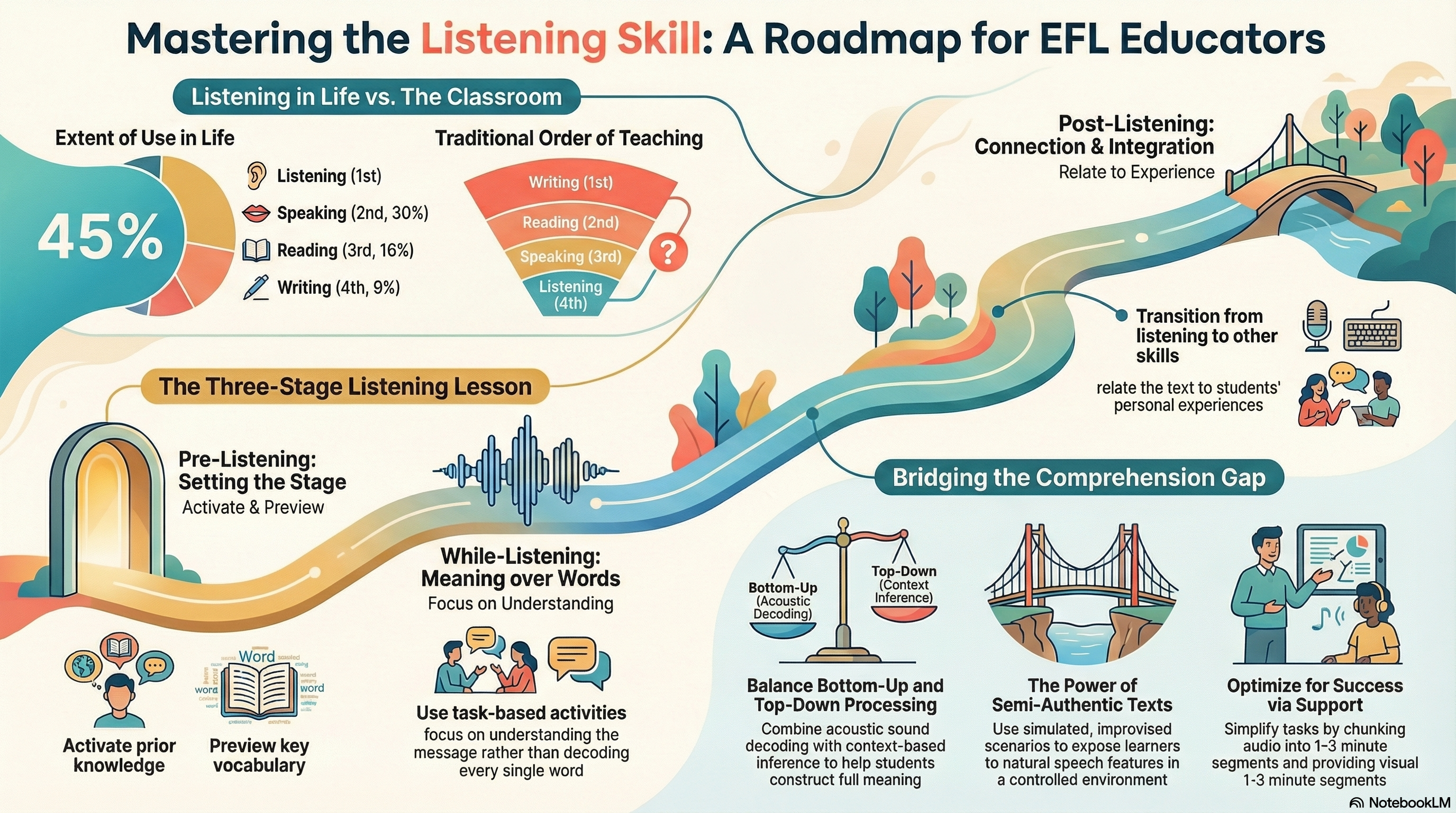
This lesson defines listening as a vital "receptive active" skill that occupies nearly half of our communication time but is frequently neglected in traditional instruction. It details how listeners use bottom-up and top-down processing to decode acoustic signals and infer meaning from contextual clues and background knowledge. The lesson provides a three-stage framework—pre-listening, while-listening, and post-listening—to activate schema, establish authentic purposes for listening, and integrate the text with other language skills. Ultimately, the goal is to move from merely testing comprehension to actively teaching the complex strategies required for real-life interactions through the use of authentic or semi-authentic texts.

At the end of Lecture 4, students will be able to:
- Define listening as a “receptive active” skill rather than a passive one, recognizing its extreme complexity and unique linguistic features such as speech rate, accent, elision, and intonation.
- Differentiate between cognitive processes, specifically bottom-up processing (using acoustic signals to recognize words and grammatical relations) and top-down processing (using schema and contextual clues to infer meaning).
- Identify and categorize types of listening, including participatory (interactional and transactional) and non-participatory listening.
- Utilize Lund’s Taxonomy to structure effective listening tasks by matching listener functions (e.g., identification, orientation, main idea comprehension) with appropriate listener responses (e.g., doing, choosing, transferring, extending).
- Design a structured three-stage listening lesson consisting of pre-listening (activating prior knowledge), while-listening (establishing an authentic purpose for understanding), and post-listening (connecting the text to personal experiences or other language skills).
-
Lecture 4
-
Watch this video summary
-
Summary Post
-
References
Anderson, A., & Lynch, T. (1988). Listening. Oxford University Press.
Buck, G. (2001). Assessing listening. Cambridge University Press.
Geddes, M., & White, R. (1978). The use of semi-scripted simulated authentic speech in listening comprehension. Audiovisual language journal, 16(3), 137-45.
Brown, G., & Yule, G. (1983). Discourse analysis. Cambridge University Press.
Lund, R. J. (1990). A taxonomy for teaching second language listening. Foreign Language Annals, 23(2), 105-115.
