-
📘Least squares method
Interpolation vs Approximation
In the context of experimental or numerical data, interpolation is the process of constructing a function that passes exactly through all given points. It reproduces the data faithfully with zero error at the points, but may sometimes produce oscillations or complex behavior between the points.
Approximation seeks a simpler function that does not necessarily pass through every point but comes as close as possible by minimizing the overall error. Such a function captures the general trend of the data while being more stable and easier to work with.
The goal of approximation is therefore to minimize the overall deviation between the approximating function and the data, which helps avoid strong fluctuations and facilitates analysis or prediction.
The essential difference is that interpolation provides a perfect match at the points, while approximation prioritizes the overall quality of the model, sometimes at the cost of local deviations.
Illustration
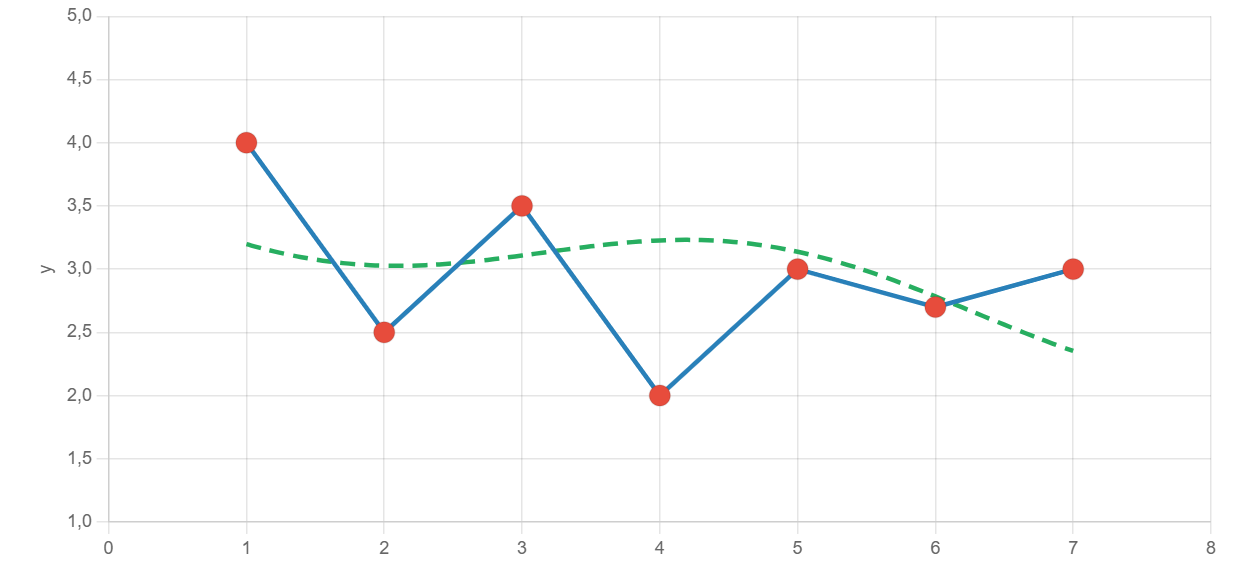
In the figure below:
- Red points represent experimental data.
- The blue line corresponds to the interpolation that passes exactly through all points.
- The green curve shows a smoother approximating function that follows the general trend without passing through every point.
 We will study in more detail the least squares method, a classical technique for computing an optimized approximating function.
