-
📘Curve Regularity and Splines
Curve Regularity and Splines
In many applications, it is essential to obtain very smooth curves passing through a large number of points. This is particularly important in computer-aided design (CAD), where we aim to represent objects with smooth shapes. As we have already seen, using high-degree polynomials can be problematic, sometimes leading to large oscillations. Therefore, high-degree polynomials are often inadequate for such tasks.
🔹 Measuring Regularity
The smoothness of a function can be measured through its derivatives. The more differentiable a function is, the smoother the associated curve, and the more regular the function is. The problem with using low-degree polynomials arises because multiple polynomials are needed to connect all points.
🔹 Piecewise Linear Interpolation
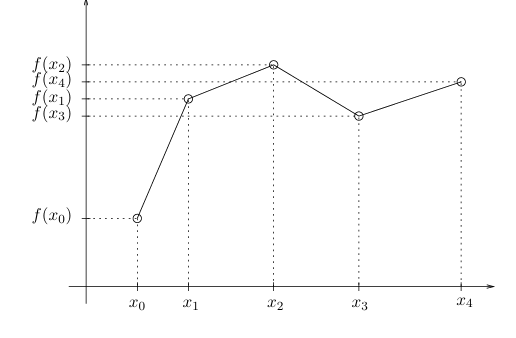
Piecewise linear interpolation connects each pair of points by a straight line segment and is also called linear splines. While simple, such curves are not suitable for designing complex objects like car bodies or airplane wings because they are continuous but not differentiable at the joints between segments. This lack of smoothness can make the curve visually and functionally inadequate for CAD purposes.
🔹 Cubic Splines
Cubic splines provide an excellent compromise between curve smoothness and the degree of polynomials used. They produce continuous and differentiable curves with relatively low-degree polynomials. Initially, we will study curves of the form \(y = f(x)\), and later, we will explore how to handle parametric curves for more complex designs.
